
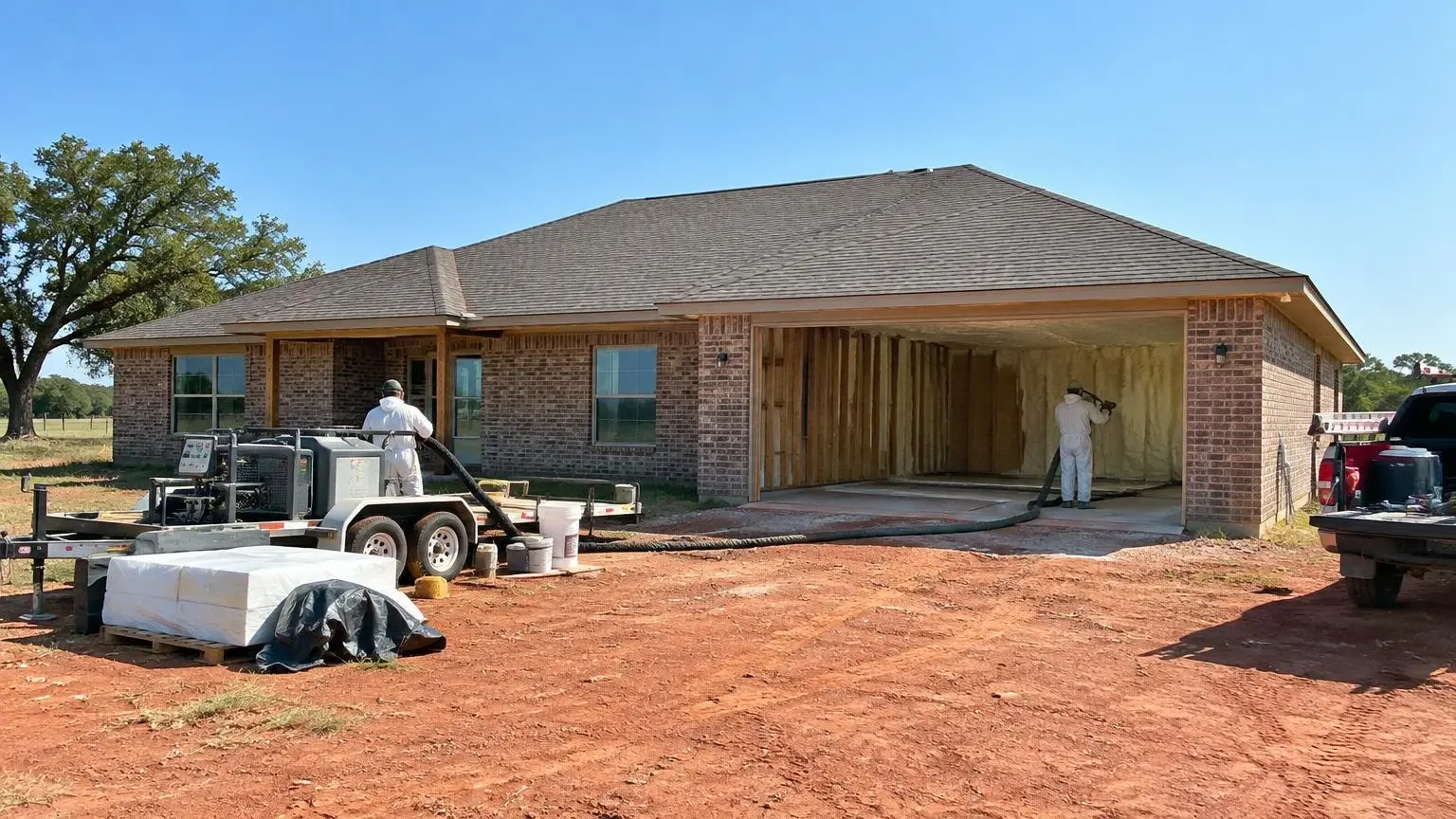
Homes, shops and barndominiums across the OKC metro
Spray Foam Insulation in Oklahoma City, OK
Keep summer heat out of the house and the ductwork: foam where it pays, blown-in where it does not, every price in writing.
- Free on-site estimates
- Written quote listing material, thickness and R-value for each area
- Attic leaks, ducts and roof stains checked before anything is covered
Insulation for Seventy Days Over 90 Degrees
Spray foam insulation in Oklahoma City is mostly about summer. The Wikipedia climate summary for the city, drawn from National Weather Service records, says temperatures reach 90F on nearly 70 days a year and 100F on about 10 days, and the Will Rogers airport normals put the average July high at 93.1F. A house that leaks air at the ceiling and keeps its ductwork in an unsealed attic fights that heat every afternoon from June to September. Oklahoma City Spray Foam Insulation seals those leaks and insulates the spaces that need it, using open-cell or closed-cell spray foam where it makes sense and blown-in insulation where it does the job for less.
Heat, humidity and the occasional hard freeze
Oklahoma City sits in a humid subtropical climate with real continental swings. The same 1991-2020 normals list an annual mean relative humidity of 64.9 percent and a January average low of 27.0F, and the city has seen a record of -17F and, as recently as February 2021, -14F. That range matters for insulation. In summer, the job is to keep attic heat and moist outdoor air from reaching the living space and the ducts. In winter, the same air leaks run the other way and pull warm air up and out through the ceiling. A tight, well insulated top of the house helps in both seasons.
Storms are the other local factor. Wikipedia counts about 150 tornadoes inside city limits since 1890, and the severe season runs from March through June. Hail and wind damage roofs, roof leaks soak attic insulation, and soaked insulation stops working. A lot of our attic work in the metro starts with a homeowner who just had a new roof put on and wants to know what shape the insulation underneath is in.
What the code asks for, and what pays
The Insulation Institute's state summary says Oklahoma's residential energy rules are based on the 2018 IECC with state amendments, in effect since September 14, 2022. Oklahoma County and the neighboring counties fall in Climate Zone 3A, where the state's prescriptive table calls for R-30 in ceilings, R-13 in wood-frame walls and R-13 (or R-5 continuous) on crawl space walls. Those are minimums for new work. For an existing attic, the Department of Energy's insulation guide recommends R-49 to R-60 in a Zone 3 attic with no insulation, and adding R-38 to R-49 where three or four inches already sit on the ceiling. Many metro homes built before the 1990s fall well short of either number once you measure the settled depth.
We measure, compare what you have against those targets, and show you on the quote where the gap is biggest. Usually that is the attic first, the walls of rooms over a garage second, and anything with a roof and no ceiling, like a shop or metal building, after that.
Closed cell vs open cell for central Oklahoma
Open-cell foam is soft and expands a lot. It fills irregular cavities, stops air movement and is the less expensive of the two per square foot; HomeGuide lists it at about R-3.5 to R-3.7 per inch. In this climate it is a common choice for the underside of a roof deck in new homes, for interior walls and for sound control. Closed-cell foam is dense and rigid, at roughly R-5 to R-7 per inch in HomeGuide's figures. It slows water vapor, does not soak up water and adds stiffness to what it is sprayed on. That makes it the usual pick for steel buildings, barndominium walls and roofs, rim areas, garage ceilings under living space and anywhere the foam may see moisture.
Neither one is right everywhere. On an open attic floor, sealing the bypasses and then blowing cellulose or fiberglass to depth is often cheaper per R-value than foaming. We tell you which approach fits each part of the building, and if two would work, both go on the quote.
Spray foam insulation cost
HomeGuide's 2026 guide puts installed spray foam at $1.50 to $5.00 per square foot: $1.50 to $3.50 for open cell and $3.00 to $5.00 for closed cell. For about 1,000 square feet, HomeGuide lists $1,500 to $5,000, and Fixr's 2025 figures for an existing home run $3,150 to $7,500. A whole house ranges from $8,000 to $20,000 in HomeGuide's numbers and $10,000 to $30,000 in Fixr's. Small jobs often hit a minimum charge, which HomeGuide puts at $1,000 to $2,000 or more.
Those are national ranges. What moves the price on a metro job is the foam type, the thickness, how easy the space is to reach, and whether old insulation has to come out first. Each service page lists the published ranges for that kind of work, and our written estimate after the visit is the price you pay.
OG&E attic insulation rebates
If OG&E supplies your electricity, check its Oklahoma attic insulation rebate before you start. OG&E's 2026 rules for Oklahoma say the existing attic insulation must be under 8 inches or R-23, the finished attic must reach at least 13 inches or R-38, the work must be done by a professional insulation company, and the home must be a single-family house on a permanent foundation that the customer owns or rents. OG&E also says income-qualified customers may receive up to $3,000 in efficiency upgrades at no added cost. Rules and amounts change, so read the current page or call OG&E, and tell us you plan to apply so the work and the paperwork line up. Customers of electric cooperatives should ask their co-op what it offers.
How to compare insulation contractors
Searching for spray foam insulation contractors near me in the metro turns up plenty of names, from spray foam insulation companies to general insulation contractors and insulation companies that mainly blow fiberglass. A few questions sort them out. Ask what they will seal before they insulate. Ask which foam they plan for each area, at what thickness, and what R-value that gives. Ask how the attic will be ventilated afterward, or whether it will become a sealed, conditioned attic, and what that means for your ductwork and any gas appliances up there. Ask how long you need to stay out after spraying; HomeGuide's guidance is at least 24 hours. Ask what happens to old insulation that is wet or dirty. And ask for the price written out area by area so you can compare quotes line for line. We put all of that in writing on every job. Get a free estimate
Common Questions
What is the recommended R-value for insulation in Oklahoma?
Oklahoma's residential code for Climate Zone 3, which covers the Oklahoma City area, calls for R-30 in ceilings and R-13 in wood-frame walls in new work. The Department of Energy recommends more for existing attics in Zone 3: R-49 to R-60 if there is no insulation, or adding R-38 to R-49 over three to four inches. OG&E's attic rebate requires the finished attic to reach at least R-38 or 13 inches.
What are the negatives of spray foam insulation?
It costs more per square foot than fiberglass or cellulose, and it is hard to remove later, so mistakes are expensive. It must be mixed and applied correctly, and the house needs to be empty while it is sprayed and for a period afterward (HomeGuide says at least 24 hours). Sealing an attic with foam also changes how the house handles air and moisture, so ventilation and any gas appliances in the attic have to be planned for.
What is the average cost per square foot for spray foam insulation?
HomeGuide's 2026 guide lists $1.50 to $3.50 per square foot for open-cell foam and $3.00 to $5.00 for closed-cell. Fixr puts spray foam in existing walls at $3.15 to $7.50 per square foot. Thickness, access and prep move the number, and our written estimate after the visit is the price.
Is closed cell or open cell better in Oklahoma City?
It depends on the surface. Open cell is common under roof decks in new homes and in interior walls. Closed cell is the usual choice for metal buildings, barndominiums, garage ceilings below living space and anywhere the foam may get damp, because it slows vapor and gives more R-value per inch.
Should I insulate the attic floor or the roof deck?
If the attic has room to work and the ducts can be sealed well, sealing the ceiling and adding blown-in insulation to depth is usually the lower-cost option. If the air handler and most ductwork sit in the attic, foaming the underside of the roof deck brings them inside the conditioned space. We look at both and price both when either could work.
Can I get a rebate for insulation from OG&E?
OG&E lists an attic insulation rebate for its Oklahoma residential customers. Its 2026 rules require existing insulation under 8 inches or R-23, a finished attic of at least 13 inches or R-38, and installation by a professional insulation company. Check OG&E's current page for amounts before you start.
What We Insulate
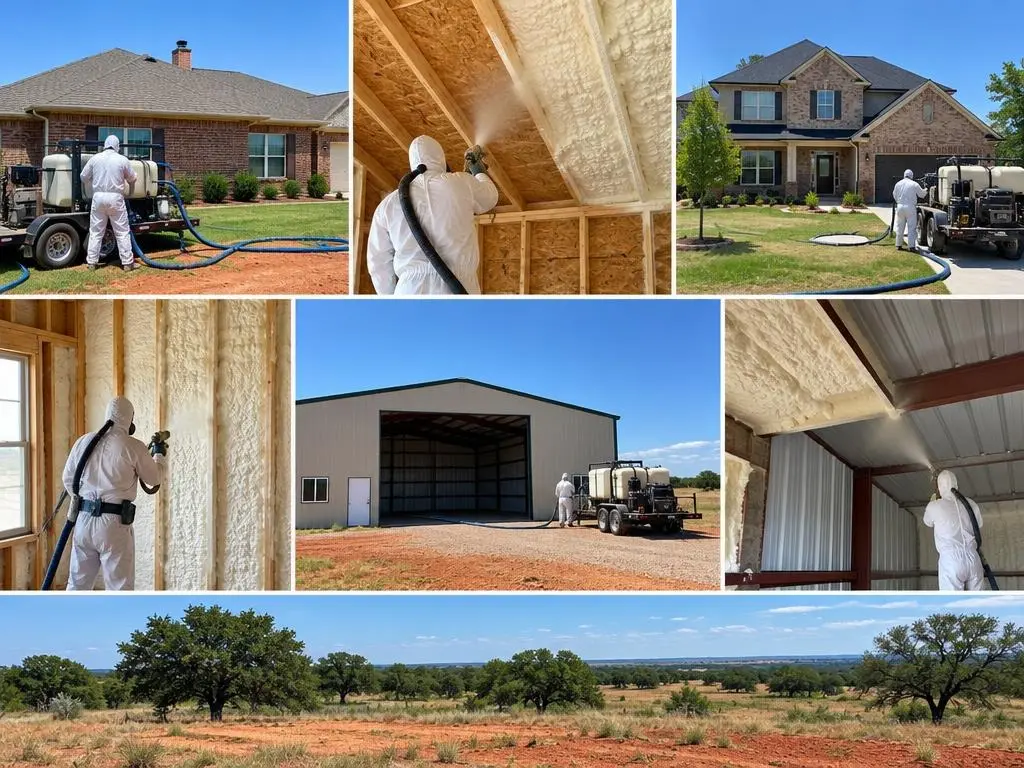
Six services that cover a central Oklahoma house from the roof deck down, plus the shops and metal buildings beside it.
Spray Foam Insulation
Open-cell and closed-cell foam for roof decks, walls, garages and steel, chosen surface by surface.
Learn more →Attic Insulation & Air Sealing
Seal the ceiling leaks, then bring the attic up to a depth that holds back Oklahoma summer heat.
Learn more →Metal Building & Barndominium Insulation
Closed-cell foam that insulates steel and stops the dripping in shops, garages and barndominiums.
Learn more →Wall Insulation
Foam in open walls on new builds and additions, and dense-pack or injection options for finished walls.
Learn more →Blown-In Insulation
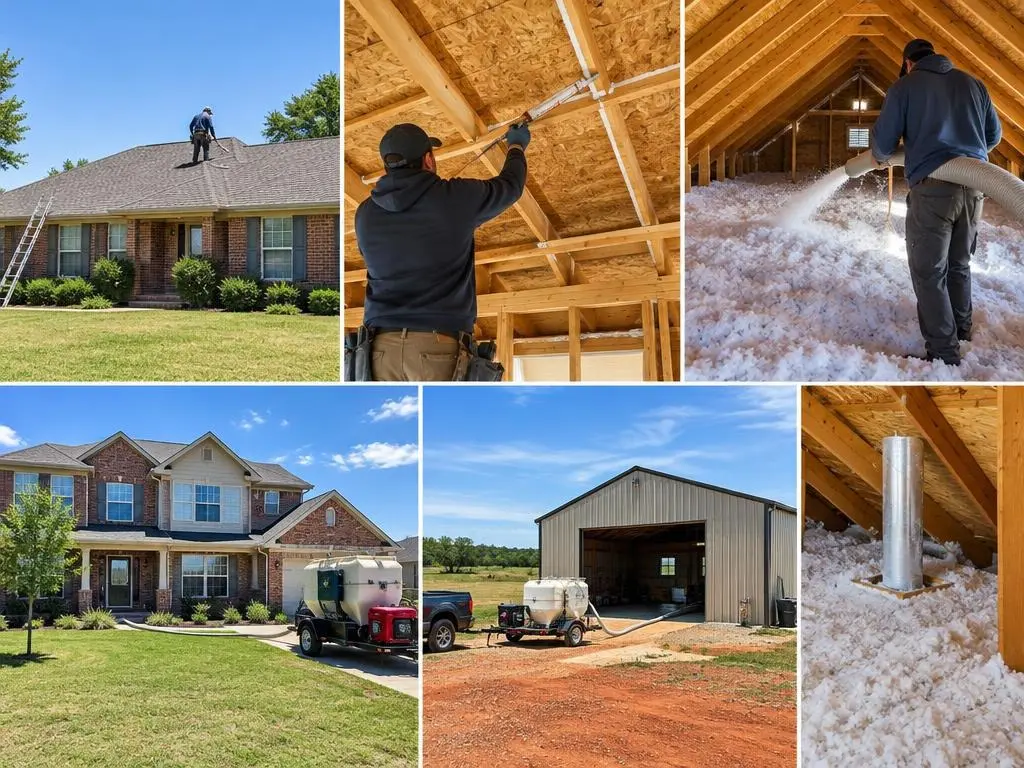
Fiberglass or cellulose blown to depth over a sealed ceiling, usually the best value in an open attic.
Learn more →Insulation Removal & Replacement
Out with wet, crushed or fouled insulation after leaks, storms or pests, then new insulation in.
Learn more →Where We Work
We work across Oklahoma, Cleveland, Canadian, Logan, McClain and Grady counties. The metro is not one housing market. Inner Oklahoma City, Warr Acres, The Village, Del City and Midwest City hold a lot of homes from the postwar boom, many of them one-story houses with low attics and decades-old insulation. Edmond, Moore, Mustang, Yukon and Norman grew fastest from the 1960s on, so attics there range from thin original fill to newer builder-grade blown-in. Nichols Hills and the historic parts of Norman and Guthrie have older, larger houses where air sealing takes patience. Toward the edges, in Piedmont, Choctaw, Harrah, Newcastle, Blanchard, Tuttle, Noble and El Reno, there are more acreages, shops, metal buildings and barndominiums.
Pick your town below for what we see there and the local facts that matter.
- Spray Foam Insulation in Oklahoma City, OK
- Spray Foam Insulation in Edmond, OK
- Spray Foam Insulation in Norman, OK
- Spray Foam Insulation in Moore, OK
- Spray Foam Insulation in Midwest City, OK
- Spray Foam Insulation in Del City, OK
- Spray Foam Insulation in Yukon, OK
- Spray Foam Insulation in Mustang, OK
- Spray Foam Insulation in Bethany, OK
- Spray Foam Insulation in Warr Acres, OK
- Spray Foam Insulation in Nichols Hills, OK
- Spray Foam Insulation in The Village, OK
- Spray Foam Insulation in Choctaw, OK
- Spray Foam Insulation in Harrah, OK
- Spray Foam Insulation in Piedmont, OK
- Spray Foam Insulation in Newcastle, OK
- Spray Foam Insulation in Blanchard, OK
- Spray Foam Insulation in Tuttle, OK
- Spray Foam Insulation in Guthrie, OK
- Spray Foam Insulation in El Reno, OK
- Spray Foam Insulation in Noble, OK
Why Homeowners Call Oklahoma City Spray Foam Insulation
We measure before we price
We check settled depth, R-value, duct runs and air leaks in person, so the quote is based on your attic and walls rather than a guess over the phone.
Foam only where it earns its cost
Roof decks, steel buildings and new walls often call for foam; open attic floors usually do better with sealing plus blown-in. You see the options side by side.
Problems found before they are buried
Roof leaks, hail damage, rodent activity, disconnected ducts and bath fans venting into the attic get pointed out before new insulation covers them.
Rebate-ready paperwork
If you plan to apply for an OG&E attic rebate, the quote and invoice list the depth and R-value before and after so the numbers are easy to report.
Get a Spray Foam Insulation Estimate
We look at the attic, walls or building in person and send a written price.